
Articles
Pleasure freed him from sexual sin: Augustine (354-430)

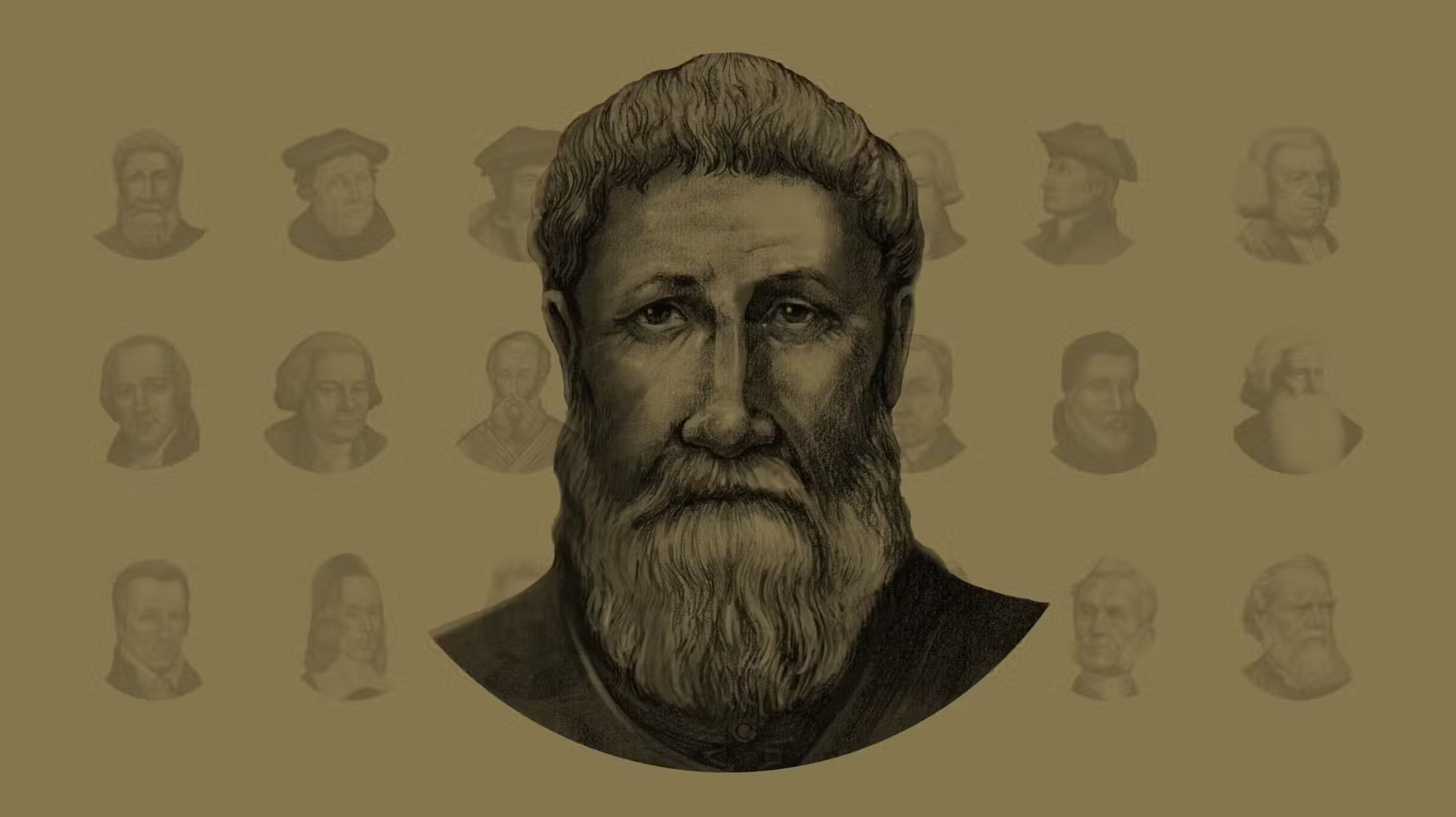
Augustine's Influence on the Western World
Augustine’s influence on the Western world is simply astonishing. Benjamin Warfield argued that through his writings Augustine «entered as a revolutionary force both in the Church and in the world, and not only created an epoch in the history of the Church, but . . . determined the course of its history in the West to the present day» («Calvin and Augustine,» p. 306). The editors of the journal Christian History simply state: «After Jesus and Paul, Augustine of Hippo is the most influential figure in the history of Christianity» (Vol. VI, No. 3, p. 2).
The hissing cauldron
Augustine was born in Tagaste, near Hippo, in modern Algeria, on November 13, 354. His father, a patrician, a farmer of moderate means, worked hard to ensure that Augustine received the best possible education in rhetoric: first in Madaura, twenty miles from home, from the age of eleven to fifteen, then, after a year at home, in Carthage from the age of seventeen to twenty.
Before Augustine left for Carthage for three years of study, his mother sternly warned him «not to commit adultery and, above all, not to seduce any strange woman.» But Augustine would later write in his Confessions: «I went to Carthage, where I found myself in the midst of a hissing cauldron of carnal desires… My real need was for You, my God, who are the food of the soul. I was not aware of this hunger» (p. 55). In Carthage, he took a woman as a concubine, with whom he lived for fifteen years and had a son, Adedatus.
Augustine became a traditional teacher of rhetoric and taught for the next eleven years of his life, from the age of nineteen to the age of thirty.
With Ambrose in Milan
When he was twenty-nine, Augustine moved from Carthage to Rome to teach, but became so fed up with the behavior of his students that he took a teaching position in Milan in 384. There he met the great bishop Ambrose.
Augustine, who had by then adopted a Platonic view of reality, was shocked by the biblical teaching that «the Word became flesh» (John 1:14). But week after week he listened to Ambrose’s sermons: «I eagerly awaited his eloquence. I also began to feel the truth of what he said, though only gradually» (Confessions, p. 108). Eventually, Augustine realized that what was holding him back was not intellectual but sexual passion: «I was still firmly entangled in the bonds of female love» (Confessions, p. 168).
So the struggle in his life was determined by which pleasure gained the upper hand. «I began to seek a way to obtain the strength I needed to enjoy You, but I could not find that way until I accepted the mediator between God and men, Jesus Christ» (Confessions, p. 152).
Fierce struggle
Then came one of the most important days in the history of the Church. This story is the heart of his Confessions, one of the great works of grace in history, and how fierce was the struggle.
This day was more difficult than is often told, but to understand the essence of the struggle, let us focus on the final crisis. It was late August 386. Augustine was almost thirty-two years old. Together with his best friend Alypius, he was talking about the outstanding sacrifice and holiness of Anthony, an Egyptian monk. Augustine felt acutely the brutal attachment he had to his lust while others were free and holy in Christ.
«We had a small garden adjoining the house where we stopped… I now found that violent feelings forced me to flee into this garden, where no one could interrupt this fierce struggle in which I was my own rival… I was in despair of the madness that would bring me reason. I was dying of the death that would bring me life… I was in despair, seized with fierce anger at myself for not accepting Your will and not entering into Your covenant… I tore my hair and beat my forehead with my fists; I covered my face with my hands and hugged my knees» («Confession», pp. 170–71).
But he began to see more clearly that the gain far outweighed the loss, and by the miracle of grace he began to realize the beauty of chastity in the presence of Christ.
«I restrained myself only in small things… They dragged my flesh after them and whispered: «Are you going to give us up? From this moment on we will never be with you again, forever and ever»… And, while I trembled at the barrier, on the other side I could see the chaste beauty of the Continent with all its calm, unsullied joy, as it modestly invited me to cross and hesitate no longer. It stretched out its loving arms to greet and embrace me» (Confession, pp. 175–76).
«"Take and read"»
So the struggle came down to the beauty of purity and its loving guardians against the little things that dragged at his flesh.
«I threw myself under a fig tree and gave way to the tears that flowed abundantly from my eyes… In my despair I continued to cry out: How much longer shall I speak—tomorrow, tomorrow? Why not now? Why not put an end to my heinous sins this very moment?» (p. 177).
Amidst his tears, Augustine heard a child's voice singing, "Take and read. Take and read.".
At this I raised my head, wondering if there was any game in which children used such words, but I could not remember ever having heard them. I held back my stream of tears and rose, telling myself that it could only be a divine command to open my book of Scripture and read the first passage that fell upon my eyes (Confessions, p. 177).
So Augustine grabbed his book of Paul’s letters, opened its pages, and stopped at Romans 13:13–14: «Let us live decently, as in the daytime—not in revelry and drunkenness, not in debauchery and debauchery, not in strife and envying, but put on the Lord Jesus Christ, and make no provision for the flesh, to fulfill its desires.».
«I had no desire to read any more, nor did I need to,» he wrote. «For at one point, when I had reached the end of a sentence, it seemed as if the light of certainty had filled my heart, and all the darkness of doubt had been driven away» (Confessions, p. 178).
Bishop of Hippo
He was baptized the following Easter, 387, at Milan by Ambrose. That autumn his mother died, a very happy woman, for the son of her tears was safe in Christ. In 388 (nearly thirty-four years of age) he returned to Africa with the intention of establishing a sort of monastery for himself and his friends, whom he called "servants of God." He renounced all dreams of marriage and pledged himself to celibacy and poverty—that is, to living in community with others. He hoped for a life of philosophical contemplation in the monastic style.
But God had other plans. Augustine’s son, Adedatus, died in 389. Dreams of returning to a quiet life in his hometown of Tagaste were dashed in the light of eternity. Augustine realized that it would be more strategic to move his monastic community to a larger city, Hippo. He chose Hippo because there was already a bishop there, so there was less chance that he would be forced to take on the role. But he misjudged the situation. The church came to Augustine and, in effect, forced him to become a priest and then bishop of Hippo, where he remained for the rest of his life.
Thus, like so many others in Church history who have left an indelible mark, he was (at the age of thirty-six) thrust from a life of contemplation into a life of action. Augustine founded a monastery on Church property and spent nearly forty years training a group of biblically-educated priests and bishops who were assigned across the continent, bringing renewal to the churches. Along the way, he defended orthodox doctrine under severe pressure and wrote some of the most influential books in Christian history, including Confessions, On Christian Doctrine, On the Trinity, and On the City of God.
The swan is not silent.
When Augustine handed over the leadership of his church in 426, four years before his death, his successor was overcome with feelings of inadequacy. «The swan is silent,» he said, fearing that the voice of this spiritual giant would be lost in time.
But the swan is not silent—not in 426, not in 2018, and not in the centuries between. For 1,600 years, Augustine’s voice has continued to call hungry sinners to enjoy the liberating, royal joy of Jesus Christ: «How sweet it was for me to suddenly be rid of those fruitless joys that I once feared to lose! … You have driven them from me, You who are the true, royal joy. You have driven them from me and taken their place, You who are sweeter than all pleasures, though not for flesh and blood, You who shine more brightly than all light, secretly hidden deeper than any secret in our hearts, You who surpass all honor, though not in the eyes of men who see all honor in themselves… O Lord, my God, my Light, my Wealth, and my Salvation» (Confessions, p. 181).
