
Articles
Biblical Theology and Church Worship

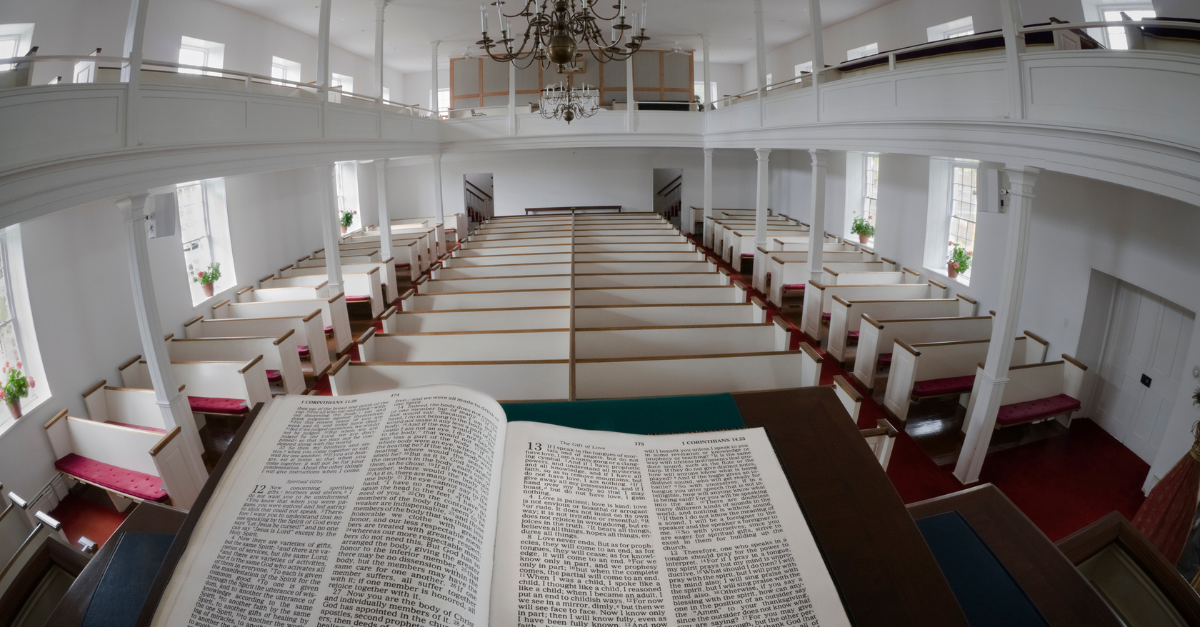
What exactly do we do when we gather as a church to worship? And how can we know exactly what we should be doing during our weekly gatherings?
Naturally, evangelical Christians look to Scripture for guidance on these matters, but where in Scripture should we turn? The Old Testament has much to say about worship—prayers, sacrifices, choirs, cymbals, and more. But does all of this material really apply to New Testament gatherings of believers?
To answer these questions, we need a biblical theology of worship. Biblical theology is a discipline that helps us trace both unity and diversity, both continuity and discontinuity, within the broad narrative of Scripture.
In this article, I will briefly outline the biblical theology of church worship. Four steps will help us do this:
- Corporate worship in the Old Testament;
- Fulfillment in Christ;
- Corporate worship in the New Testament;
- Reading the entire Bible to understand corporate church worship.
1. Corporate Worship in the Old Testament
Ever since humans were driven out of Eden from God's presence after the Fall in Genesis chapter 3, God has been working to gather them back to Himself.
When Israel suffered in slavery in Egypt, God delivered them not only so that they would be free from oppression but so that they could worship Him in His presence (Ex. 3:12, 18). God led His people out of Egypt and brought them to His own dwelling place (Ex. 15:13, 17).
Where is this place of God’s dwelling? Originally it was the tabernacle, a magnificent tent where the priests offered sacrifices for the sins and uncleanness of the people. In Exodus 29:44–46 we read:
«I will consecrate the tent of meeting and the altar. I will also consecrate Aaron and his sons to serve me as priests. I will live among the people of Israel and be their God. And they will know that I am the Lord their God, who brought them out of the land of Egypt so that I could live among them. I am the Lord their God.».
The purpose of the Exodus was for God to live among His people, and He does this through a holy place (the tabernacle) and a people (the priesthood) who were appointed for that purpose.
When God brought Israel out of Egypt, He accepted them as His people. The way He confirmed this new relationship with Israel was by making a covenant with them, often called the «Mosaic covenant» (Ex. 19:1–6). All of the laws in the books of Exodus, Leviticus, Numbers, and Deuteronomy detail the terms of this covenant, specifying how God’s people were to live with God and with one another.
Thus, the detailed descriptions of sacrifices and purification rituals in Leviticus are not simply religious symbolism. They are means by which the ruptures in the covenantal communion between God and his people are repaired. The cultic prescriptions uphold the validity of the covenant. They serve as a mechanism for restoring the broken relationship with God.
Several times a year all Israelites were commanded to gather before the Lord at His tabernacle for the feasts of Passover, Firstfruits, etc. (Lev. 23). Apart from these feasts, regular sacrifices were performed by the priests, and individual Israelites came to the tabernacle (and later to the temple) only when a specific sacrifice was required for sin or impurity.
In other words, for Israel, corporate worship was a special event that occurred several times a year. Worship, understood as exclusive devotion to the Lord, was something the Israelites were to practice 24/7 (Deut. 6:13–15). But in the sense of close access to God’s presence, worship was limited to specific people, places, and times. Yes, God lived among His people, but that presence was limited to the tabernacle and guarded by the priests.
2. Fulfillment in Christ
The turning point in the story of Scripture is the incarnation of God’s Son, our Lord Jesus Christ. All the promises of God are fulfilled in Him (2 Cor. 1:20). All the Old Testament types—the institutions of priesthood, temple, and kingdom, the events of exodus, exile, and return—find their fulfillment in Him. So to understand the theology of worship presented throughout Scripture, we need to understand how Jesus fulfills and transforms the worship of the Mosaic covenant.
The tabernacle, and later the temple, was the place where God manifested his presence among his people; Jesus fulfills and therefore replaces these Old Testament structures. John tells us that the Word became flesh and—literally—«dwelt» among us (John 1:14). Jesus promises, «Destroy this temple, and in three days I will raise it up» (John 2:19). In other words, Jesus’ body is now the temple, the place where God meets with his people, manifests his presence, and removes their sins (John 2:21–22). This is why Jesus can say that the hour is coming when true worshippers will no longer need to worship in Jerusalem, but will worship in spirit and truth (John 4:21–24).
Jesus fulfills and replaces the earthly temple in Jerusalem. It is now «the place» where true worshipers worship God.
Jesus also fulfills and replaces the entire sacrificial system associated with the Mosaic covenant, its tabernacle, and temple. The book of Hebrews explains that, unlike the priests who had to offer sacrifices daily, Jesus atoned for the sins of the people once and for all «by offering himself» (Heb. 7:27). Jesus’ one sacrifice not only cleanses the body, as the Old Testament sacrifices did, but it also cleanses our consciences, renewing us inwardly (Heb. 9:13–14). Because Jesus has perfected His people by one sacrifice, there is no longer any need for the sacrifices of bulls and goats (Heb. 10:1–4, 10, 11–18).
Jesus fulfills and replaces the Levitical sacrifices. His blood now provides our eternal redemption (Heb. 9:12).
I could go on and on. The point is that Jesus’ redemptive work leads to a radical change in the way God deals with His people. The new covenant that Jesus establishes makes the old covenant—the covenant God made at Sinai through Moses—obsolete (abolished) (Heb. 8:6–7, 13). God’s people now receive forgiveness of sins through faith in Jesus’ sacrifice. God’s people now experience His gracious presence through faith in Christ and the indwelling of the Holy Spirit. Now all of God’s people have close access to God (Heb. 4:16, 10:19–22), not just a few priests.
3. Corporate Worship in the New Testament
What does all this mean for corporate worship in the new covenant era? The first thing to note is that the Old Testament conditions of worship were applied to the entire life of believers. In Romans 12:1, Paul writes:
«"Therefore I urge you, brothers, by the mercies of God, to present your bodies as a living sacrifice, holy, acceptable to God, which is your reasonable service.".
Now we do not sacrifice animals, but ourselves. The whole life of a Christian is an act of sacrificial service to God.
Or consider Hebrews 13:15:
«"Therefore, through Him let us continually offer a sacrifice of praise to God, that is, the fruit of lips giving thanks to His name.".
Praise is our sacrifice, and we offer it constantly—not just for an hour on Sunday morning. The fruit of lips that confess God’s name includes, but is not limited to, songs of praise: it is boldly confessing the Gospel publicly, speaking words of truth and love to others, and subjecting every word we speak to Christ.
This means that «worship» is not something we do primarily in church on Sunday. Instead, worship should permeate our entire lives. For a Christian, worship is not limited to sacred times and places, for we are one in faith with Christ, who is the temple of God, and we are filled with the Holy Spirit, which makes us both individually and corporately the temple of God (1 Cor. 3:16–17, 6:19; cf. Eph. 2:22).
What are the characteristics of corporate worship in the new covenant?
- Reading and preaching the Scriptures (1 Tim. 4:14);
- Singing psalms, hymns, and spiritual songs together (Eph. 5:18–19; Col. 3:16);
- Prayer (1 Tim. 2:1–2, 8);
- The performance of the sacraments (water baptism and the Lord's Supper) (Matt. 28:19, 1 Cor. 11:17–34);
- Incite one another to love and good works (Heb. 10:24–25).
One of the most striking features of corporate worship in the New Testament is the constant emphasis on the edification of the whole body. Paul writes, «Let the word of Christ dwell in you richly in all wisdom, teaching and admonishing one another, singing psalms, hymns, and spiritual songs with gratitude in your hearts to God» (Col. 3:16). We teach and admonish one another when we sing to the Lord. We strengthen one another in psalms. Paul even emphasizes that everything that happens in the congregation should be for the edification of the body in Christ (1 Cor. 14:26).
The uniqueness of the weekly local church gathering is not only that it is a time for worship, but that it is a time for communal edification as we worship God together.
With the New Covenant instituted by Christ, corporate worship in the New Testament era took on a very different structure than that of the Old Testament. Believers now gather for corporate worship every week, not just a few times a year. Instead of the temple in Jerusalem, they meet in local churches wherever they live. God’s presence is no longer confined to the Holy of Holies or guarded by priests—now God lives in all his people through the Spirit, and Christ is present among them wherever they gather (Matt. 18:20). Instead of performing a complex series of sacrifices and offerings, Christians gather to hear the Word, preach the Word, pray the Word, sing the Word, and see the Word in the sacraments. All of this is directed toward the building up of the body in love so that we may all attain maturity in Christ (Eph. 4:11–16).
4. Reading the entire Bible to understand corporate church worship
So, how can we turn to Scripture to learn what to do during corporate worship?
First, it is important to affirm that Scripture does teach us what we should do in regular church gatherings. Remember that while all of life is worship, the weekly church meeting has a special place in the Christian life. All Christians are obligated to gather together (Hebrews 10:24–25); church attendance is not optional for a Christian. This means that, in essence, everything the church does in worship becomes a mandatory practice for its members. Paul urges Christians not to allow any human rules or practices of worship to impose restrictions on their conscience (Col. 2:16–23).
I would say that these biblical principles are summed up in what has historically been called the «regulatory principle» of worship. This means that in their corporate gatherings, churches should only engage in practices that are clearly prescribed in Scripture, both by explicit command and by normative example. To do otherwise would be to undermine Christian freedom. So churches should look to Scripture for guidance on how to worship together, and do only what Scripture directs.
But this raises the question: What exactly does Scripture tell us to do? More specifically, how can we determine which biblical materials on worship are normative and binding? Answering this question would take up a book in its entirety; here I offer the briefest overview.
Defining the biblical teaching on worship requires special effort, since Scripture does not provide a complete, overtly normative «order of service.» However, there are several commandments in the New Testament that are clearly binding on all churches.
For example, the churches in Ephesus and Colossae were commanded to sing (Eph. 5:18–19; Col. 3:16), and the church in Corinth is mentioned as singing (1 Cor. 14:26), indicating the importance of singing for all churches. Paul also encourages Timothy to read and preach the Scriptures in a letter written to teach how the church should behave (1 Tim. 3:15; 4:14). This indicates that reading and preaching the Scriptures is God’s will not only for that church but for every church.
On the other hand, some commandments, such as «Greet one another with a holy kiss» (Rom. 16:16), seem to express a universal principle («Greet one another with Christian love») in a form that may not be culturally universal.
Additionally, some contextual commands may have a broader meaning, such as Paul telling the Corinthians to set aside money on the first day of the week. This was for a specific collection for the saints in Jerusalem, but all churches are obligated to financially support their teachers (Gal. 6:6), so giving can certainly take place in corporate worship.
So far we have only looked at the New Testament. What about the Old Testament? After all, the Old Testament contains many commandments regarding worship:
«Praise him with the sound of the trumpet, praise him with the psaltery and harp! Praise him with the timbrel in dances, praise him with strings and flute! Praise him with the resounding cymbals, praise him with the loud cymbals!» (Ps. 150:3–5)
Does this mean that in order to be biblical, our church gatherings must include trumpets, harps, lyres, timpani, dancing, stringed instruments, and cymbals? I would say no.
Remember that the Psalms are an expression of worship under the Mosaic covenant, which some New Testament writers call the «old covenant» (Heb. 8:6). Now that the New Covenant promised in Jeremiah 31 has come, the old covenant has lost its force. We are no longer under the law of Moses (Rom. 7:1–6; Gal. 3:23–26).
So the forms of worship associated with the Mosaic era are not binding on us either. The temple was served by priests, some of whom specialized in liturgical music (1 Chron. 9:33). In fact, they played the same instruments mentioned in Psalm 150 (2 Chron. 5:12, 13; 9:11). So Psalm 150 does not provide a template for Christian worship; instead, it refers to a specific form of Old Testament worship associated with the temple and the Levitical priesthood.
This does not resolve the question of what kind of instruments might be appropriate accompaniments for congregational singing in the church. But it does mean that simply appealing to Old Testament precedents is inappropriate, just as appealing to Old Testament precedents cannot legitimize animal sacrifice. This is where many Christian traditions fall short in their biblical theology of worship, selectively appealing to Old Testament precedents as if certain features of the Levitical priesthood and temple worship were being carried over into the New Testament era.
Of course, much of the Old Testament shapes the way we worship. The Psalms teach us to worship with awe and fear, joy and delight, gratitude and joy. However, the Old Testament does not establish any elements or forms of worship for the New Testament church.
In this sense, the New Testament becomes a new «constitution» for God’s people in the new covenant era, just as the Old Testament was a constitution for God’s people in the old covenant period. Although God has one plan of salvation and one people whom He saves, the way God’s people interact with Him has changed radically with the coming of Christ and the establishment of the new covenant.
That is why we need to use all the tools of biblical theology—connecting covenants, tracing connections between type and antitype, observing promises and their fulfillment, distinguishing between continuity and discontinuity—to arrive at a theology of corporate worship. As Christ’s new covenant people, filled with the promised Holy Spirit, we worship in Spirit and in truth, according to the terms that God himself has set out in Scripture.
[1] For a biblical theology of worship that has profoundly influenced my approach, see David Patson, Engaging with God: A Biblical Theology of Worship (Downtown Grove: InterVarsity Press, 1992). [2] For a basic introduction to the storyline of Scripture, using the theme of the gathering of God’s people as a primary lens, see Christopher Ash, Remaking a Broken World: A Fresh Look at the Bible Storyline (Milton Keynes, UK: Authentic, 2010). [3] For a more detailed discussion of the trajectory of the temple throughout the canon, see G. K. Beale, The Temple and the Church's Mission: A Biblical Theology of the Dwelling Place of God, New Studies in Biblical Theology 17 (Downtown Grove, IL: InterVarsity Press, 2004). [4] For a concise defense of the «regulatory principle,» see Jonathan Lyman, Regulating Like Jazz, and the first three chapters Give Praise to God: A Vision for Reforming Worship, eds. Philip Graham Ryken, Derek W. H. Thomas, and J. Ligon Duncan III (Phillipsburg, NJ: Presbyterian & Reformed, 2003).